
Featured

26 Mar 2026
6 min read
Noor Kaur
Stock Market Meaning: A Beginner’s Guide to Investing in India
Key Takeaways
Stock market meaning is a financial marketplace to buy and sell securities of publicly listed companies.
It provides opportunities to participate in the company’s growth and build long-term wealth.
Understanding the market movements is as important as identifying investment opportunities.
Patience, discipline and long-term perspective are essential for successful investing.
Introduction:
A stock market might seem overwhelming and confusing to someone just starting with it. Financial news platforms constantly discuss companies, their share prices and potential market trends. Along with this, one side of the screen shows NIFTY 50, S&P BSE Sensex, in the middle, there is a constant flip of shares’ prices going either up or down, and a few minor details.
Do not worry, as understanding this market isn’t as difficult as it looks. As a beginner, it is completely normal to find it difficult. As they say, if someone is curious and willing to learn, nothing is difficult to understand.
This blog explains the stock market meaning and its fundamentals with relevant topics for beginners.
The Fundamentals of the Stock Market :
Its fundamentals aren’t just about learning technical metrics, but also:
Ability to analyse price movements during trading or investing.
Able to understand market trends and price patterns.
Able to analyse company fundamentals like revenue, profit & growth potential.
Learn to manage risk and build a diversified portfolio.
Staying updated with market news and economic developments.
Stock Market Meaning:
It is informally called as shares market, even though there is a slight difference between them. It is a marketplace where investors buy and sell shares of publicly listed companies. In India, such exchanges are occurring via Stock Exchanges (like the National Stock Exchange - NSE, and Bombay Stock Exchange - BSE). A share is essentially the unit of ownership of a Public Limited Company, thus buying a share in the stock market is like buying a slice of that company.
The idea of dividing ownership into smaller units, called shares, emerged when business ventures were becoming large and expensive during long-distance trade and industrial revolution. Building large-scale products or other innovations need a huge capital which is difficult and risky for one person to invest such large sums. So, the structure of investing in shares, a company receiving capital to grow its business and in return, investors earn the profitable returns if it performs well, made it possible to fund large-scale enterprises, support innovation, and expand industries.
How does the equity market work?
The following steps show the clear process of how buying and selling work:
A company raises its capital by offering shares to the public through an Initial Public Offering (IPO) that can be traded on stock exchanges.
Investors must open their trading account, demat account and link a bank account to begin trading.
Before buying shares, investors must:
Research the companies’ financial performance and growth prospects.
Through the trading platform, the investor places a buy order, specifying the number of shares and the price they are willing to pay.
The stock exchange matches this order with a seller willing to sell at the same price.
Once the order is matched, the trade is executed and the shares are credited to the investor’s demat account, while the payment is deducted from the investor’s account. This makes the investor, a shareholder of the company.
After purchasing shares, investors may expect the prices to increase and hold them for long-term. Some companies distribute a portion of their profits to shareholders in the form of dividends.
An investor who is selling their shares follow the same process as buying the shares, only the shares are transferred from the seller’s demat account to the buyer’s account.
After the shares are sold, the sale amount is credited to the investor’s trading account, and then transferred to their bank account.
Investors earn a profit when the selling price is higher than the buying price and incurs a loss if the price falls below the purchase price.
Conclusion:
Individuals must prioritise learning the fundamentals of the stock market. They need to understand how it works, research companies carefully, manage risk, and maintain a long-term approach, something that can be supported through a stock market app. Investing in equities helps build wealth, but it requires patience, informed decisions, and continuous learning.
Frequently Asked Questions (FAQs):
1. What is a stock market?
A stock market meaning is where investors buy and sell stocks of publicly listed companies. The National Stock Exchange of India and the Bombay Stock Exchange are examples of stock exchanges in India.
2. What is the significance of buying a share?
Buying a share of a company denotes a very small portion of ownership in it.
3. What is the best way for a beginner to start investing in stocks?
An investor needs a demat and a trading account to invest in a stock market, research of the companies, and an authorized broker.
4. Who regulates a stock market in India?
In India, it is regulated by the Securities and Exchange Board of India (SEBI), which is an authorised body that makes sure that the operations of stock markets are done transparently.
5. What is a Demat account?
A Demat account is an account which can hold shares or other securities in an electronic form.
6. How can an investor make money from stock investment?
An investor can make money from an investment in a stock through price appreciation or through dividends.
7. Is the stock market risky?
Investing in the stock market involves risk as a company's share prices fluctuate due to economic, business and market factors.
8. What is a market index?
The overall condition of the stock market is reflected through market indices such as NIFTY 50, S&P BSE Sensex and many others.
Share on:


RelatedBlogs

14 Oct 2026
Featured
Read MoreWhat Is a Butterfly Spread and When Is It Used?
Learn what a butterfly spread is in options trading, how it works in f&o trading, and when traders typically use this strategy.

12 Oct 2026
Featured
Read MoreHow PMS Portfolios Are Benchmarked and What "Alpha" Really Means for Investors
Confused about how PMS portfolios are benchmarked and what alpha actually means? Here's a plain-English breakdown before you invest.
22 Aug 2026
Featured
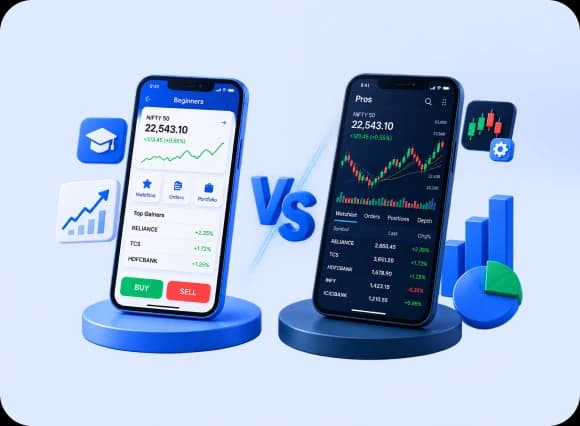
Read MoreTrading App Comparison: What Beginners vs Pros Should Look For
Choosing a trading app? See what beginners and pros should check in a trading platform, from charts to order speed, before you start trading.
22 Aug 2026
Featured
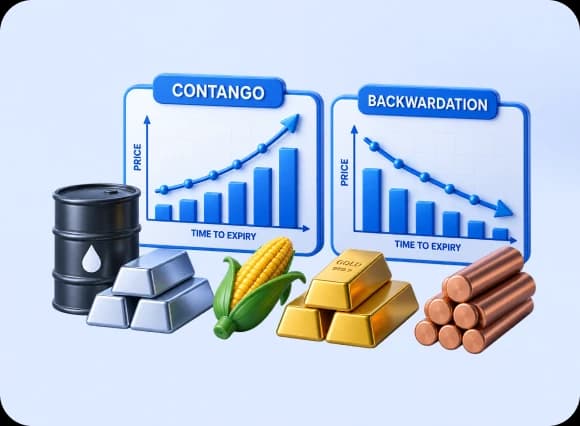
Read MoreContango vs Backwardation in Commodity Futures Explained
Understand contango and backwardation in commodity futures, what drives them, and how traders use these signals to plan smarter trades.
Subscribe for Newsletter
Share on:
Open a Free Demat Account with us only in few minutes
By processing, you agree terms & conditions.

Open a Demat Account in 5 minutes !

Step 01
Click on the button below to open your new account.

Step 02
Fill out some basic details to get started.

Step 03
Upload your documents to verify your account.

Step 04
Start trading within just 24 hours of registration.
Commonly Asked Questions
It is simple and paperless. Visit our website, enter your mobile number, and complete the e-KYC process to open a demat account instantly. Our digital onboarding ensures you can start investing in minutes without physical paperwork.
We unify speed, stability, and advanced tools in one place. Unlike basic apps, our ecosystem offers deep analytics, algo capabilities, and expert support, making us the preferred platform for trading for both beginners and professionals.
A demat account acts like digital storage for your shares and securities, while a trading account is the interface used to buy and sell them. At mastertrust, you get both linked seamlessly for a smooth investment experience.
With over 41+ years of market presence, we combine trust with modern technology. Our transparent pricing, personalised guidance, and regulatory compliance make us one of the preferred stock brokers in India for secure wealth creation.

Slide 1 of 1