
Market recap

23 Mar 2026
8 min read
Noor Kaur
Upper Circuit & Lower Circuit in the Share Market: Explained
Key takeaways:
The content explains the meaning of upper and lower circuits
The existence of circuit limits is explained
Unchecked price movements can harm market stability
It explains how upper circuits create buying pressure with limited sellers and vice versa
Common misconceptions about circuits are addressed
Introduction:
Stock markets are full of risks. There are sudden upward or downward shifts in a share’s value or other assets. These shifts are sharp price movements, which reflect rapid changes in supply or demand and risk perception, indicating high volatility.
However, if the price swings remain unchecked, they lead to severe consequences for both investors and the economy. Unchecked volatility often drives panic selling with unjustified drops in the asset prices.
To control such extreme movements, stock exchanges impose a circuit limit.
Circuit Limits in Equity Trading:
Circuit limits are exchange-set rules that prevent stock prices from fluctuations. There are two types of circuit limits:
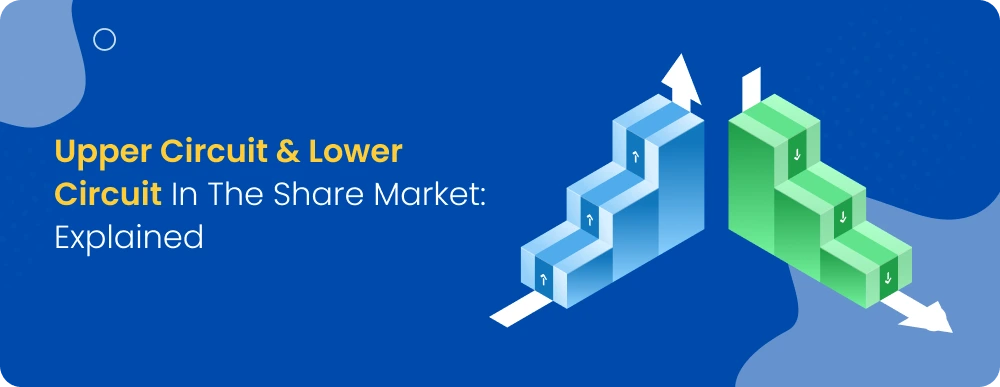
Upper Circuit
Lower Circuit
In this blog, upper and lower circuits are explained in detail, along with their importance for anyone involved in equity trading. This is for those investors who are beginners, intraday traders, or long-term market participants.
Upper Circuit
It refers to the maximum price limit a stock is allowed to reach during a single trading session. The term “upper” means it acts as a price ceiling. Once a stock hits it:
Buyers queue at the upper circuit price
Sellers are scarce
Price movement stops upward
The stock may show “UC” status
In intraday equity trading, traders can use it as both an opportunity and a risk, as:
Buying before the upper circuit may give profits
Buying at the upper circuit carries liquidity risk
For example, if a stock closed at Rs. 100 and has a 10% upper circuit, then the upper circuit price would be Rs. 110, and the stock cannot trade above Rs. 110 for that day.
This concept is critical in equity trading, especially during speculative buying.
Lower Circuit
It is the maximum downward price limit a stock can reach during a trading session. The term “lower” means it acts as a price floor. When a stock hits its lower circuit:
Sellers dominate the order book
Price stops falling further
Buyers may disappear
The stock may show “LC” status
Exit becomes difficult
Lower circuits are particularly dangerous for intraday and leveraged equity trading.
For example, if a stock closes at Rs. 200 with a 10% lower circuit, then the lower circuit price would be Rs. 180, and the stock cannot trade below Rs. 180 for that session.
Lower circuits are especially relevant during market crashes or negative corporate announcements like operational failures, strategic setbacks and more.
Existence of Circuit Limits in Equity Trading:
Moving forward with the basics, it is crucial to know why these circuits exist. Upper and lower circuits act as cooling-off mechanisms to protect the equity market from extreme volatility.
The objectives of these limits are:
Prevent panic buying or selling
Control excessive speculation
Protect retail investors
Ensure orderly equity trading
Avoid price manipulation
Without circuit limits, stock prices would fluctuate erratically, harming both investors and market confidence.
For more clarity, a table below shows the relevant differences between the two circuits-
Calculation of Circuit Limits:
Circuit limits are calculated as a percentage of the previous day’s closing price.
The formula for these limits is listed below:
Upper Circuit Limit (Maximum Price) = Previous Close + (Previous Close * Circuit Percentage)
Lower Circuit Limit (Minimum Price) = Previous Close - (Previous Close * Circuit Percentage)
The common circuit limit percentages in India are 2%, 5%, 10% and 20%. The applicable limit depends on stock category, market capitalisation, volatility history and exchange rules (NSE/BSE).
In the Indian equity market, SEBI regulates circuit limits, and NSE and BSE implement them.
Risks with Limits in Intraday Trading:
Intraday traders must be extremely cautious with these limits, as the following risks exist:
Position gets stuck
No buyers or sellers present
Unexpected losses
Forced carry-forward
Professional equity trading desks often avoid stocks near circuit limits unless liquidity is sufficient.
Circuit Breakers and Circuit Limits are Different:
Many traders confuse circuit breakers with upper and lower circuits, but they are different. Though both work together to protect the equity trading ecosystem.
Circuit Breakers
They are market-wide mechanisms that temporarily stop trading across the entire exchange to prevent widespread panic and market crashes.
They apply to the entire index, like Nifty and Sensex.
They halt trading across the entire stock exchange for all stocks.
Circuit Limits
They apply only to individual stocks.
They prevent panic and give investors time to think.
When a stock hits its circuit limit, trading is paused only for that specific security. A pre-open session is then conducted to discover a new equilibrium price before trading resumes.
Conclusion:
Upper and lower circuits act as key risk control mechanisms in the equity market. They influence price movement, trader behaviour, and investor protection, helping market participants stay disciplined rather than reactive, especially when tracked through a share market app.
Frequently Asked Questions (FAQs):
1. Is trading near circuit limits safe for beginners?
No, trading near circuit limits is not considered safe for beginners as circuit-hit stocks involve high volatility, emotional trading and execution challenges like stuck orders. Beginners should focus on highly liquid stocks.
2. Why do orders get stuck when a stock hits a circuit?
Orders get stuck because circuit limits create an imbalance between buyers and sellers. At the upper circuit, sellers are scarce, while at the lower circuit, buyers may disappear.
3. Does hitting an upper circuit mean guaranteed profit?
No, hitting an upper circuit doesn’t mean guaranteed profit, as prices may reverse in subsequent sessions, especially if the move is driven by short-term news or speculations rather than fundamentals.
4. Does a lower circuit mean the company is fundamentally weak?
No, a lower circuit doesn’t mean that the company is fundamentally weak, as a lower circuit occurs due to temporary negative news, market-wide panic or short-term sentiment shifts.
5. Do circuit limits act as stop-loss protection?
No, circuit limits don’t act as stop-loss protection, as when a stock hits a lower circuit, stop-loss orders may fail to execute due to the absence of buyers.
6. How are circuit limits different from circuit breakers?
Circuit limits and circuit breakers both regulate stock market volatility, but they differ in application. Circuit limits apply to individual stocks to protect investors from sudden price fluctuations in individual shares, and circuit breakers are percentage triggers that halt the entire exchange to prevent market-wide panic selling.
7. What is the biggest mistake traders make around circuit limits?
The biggest mistake traders make around circuit limits is chasing circuit-hit stocks without considering liquidity and exit risk.
Share on:


RelatedBlogs

29 Aug 2026
Market recap
Read MoreEvaluate a PMS Manager's Track Record: Investment Portfolio Guide
Learn how to check a PMS manager's real track record before you commit your investment portfolio. Rolling returns, drawdowns, TWRR, and fees explained.

23 Mar 2026
Market recap
Read MoreSystematic Investment Plans: Key Things to Know
Explore Systematic Investment Plans (SIP) in detail, including their types, benefits, and how they work. Learn how to choose the best SIP based on your risk profile, financial goals, and investment horizon to build long-term wealth through disciplined and consistent investing.
11 Nov 2025
Market recap
Read MoreHow Margin Trading Facility (MTF) Interest Rates Affect Your Return
MTF lets you buy more shares with limited capital, the interest charged on borrowed funds becomes a crucial factor in determining your net gains.

13 Aug 2025
Market recap
Read MoreGeopolitical Events And Their Effects On Financial Markets
Geopolitical events—like wars, trade disputes, and elections—create uncertainty, driving market volatility, currency fluctuations, and shifts in commodity prices. They impact investor sentiment, trade flows, and capital movement. Understanding these effects helps investors manage risk, hedge portfolios, and make informed decisions during turbulent times.
Subscribe for Newsletter
Share on:
Open a Free Demat Account with us only in few minutes
By processing, you agree terms & conditions.

Open a Demat Account in 5 minutes !

Step 01
Click on the button below to open your new account.

Step 02
Fill out some basic details to get started.

Step 03
Upload your documents to verify your account.

Step 04
Start trading within just 24 hours of registration.
Commonly Asked Questions
It is simple and paperless. Visit our website, enter your mobile number, and complete the e-KYC process to open a demat account instantly. Our digital onboarding ensures you can start investing in minutes without physical paperwork.
We unify speed, stability, and advanced tools in one place. Unlike basic apps, our ecosystem offers deep analytics, algo capabilities, and expert support, making us the preferred platform for trading for both beginners and professionals.
A demat account acts like digital storage for your shares and securities, while a trading account is the interface used to buy and sell them. At mastertrust, you get both linked seamlessly for a smooth investment experience.
With over 41+ years of market presence, we combine trust with modern technology. Our transparent pricing, personalised guidance, and regulatory compliance make us one of the preferred stock brokers in India for secure wealth creation.

Slide 1 of 1