
Investing

30 Dec 2025
9 min read
Noor Kaur
Intraday Trading: Meaning, Risks & Essentials for Beginners
Key Takeaways:
- Intraday trading involves buying and selling shares within the same trading session.
- It focuses on short-term price movements and requires quick decision-making.
- Effective risk management, including stop loss and position sizing, is essential.
- Choosing liquid stocks and following market trends improves trade execution.
- Discipline and consistency play a crucial role in successful intraday trading.
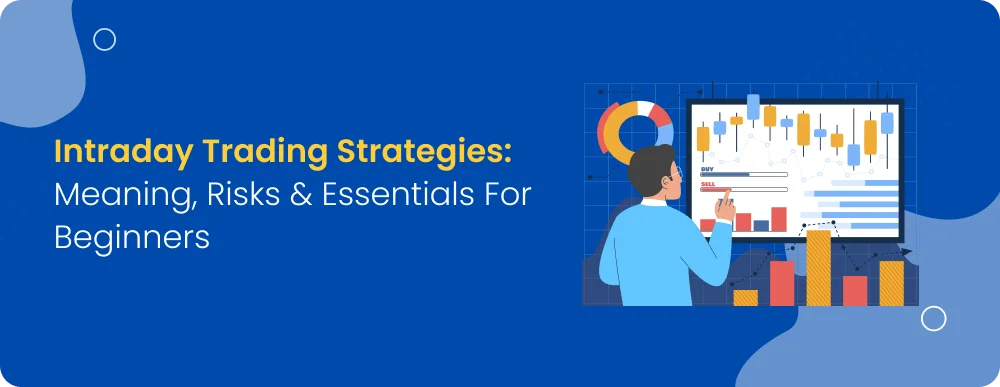
In intraday trading, shares are bought and sold within the same trading session, with all positions squared off before the market closes. As share prices fluctuate throughout the day, traders aim to capitalise on short-term price movements.
Compared to long-term investing, intraday trading carries higher risk, particularly for beginners. However, with sound market knowledge and effective risk management strategies, it can also offer profit opportunities.
In this blog, we share practical intraday trading tips suitable for beginners, as well as intermediate and advanced traders.
What Is Intraday Trading?
Intraday trading refers to buying and selling shares within the same trading session, without carrying positions overnight. The objective is to capitalise on short-term price movements occurring during market hours.
Suggested Read: How to select stock for intraday one day before
Intraday Trading Tips For Beginners:
Understanding the fundamentals is the first and most important step for anyone starting intraday trading. Focus on the following areas:
- Learn commonly used trading terms such as ask price, bid price, bid-ask spread, scalping, day orders, alpha, beta, and more.
- Watch beginner-friendly educational videos to understand how intraday trading works in real market conditions.
- Gain basic knowledge of technical analysis to identify trends, support, and resistance levels.
Capital Gains and Capital Losses in Intraday Trading:
Intraday trading involves both capital gains and capital losses, and following the right intraday trading tips to minimize losses and maximize gains can help traders manage risk more effectively. A capital gain occurs when a trader buys an asset at a lower price and sells it at a higher price within the same trading session, while a capital loss happens when the asset is sold for less than its purchase price.
A careful study of market movement helps minimise capital losses. Some of these are:
Key Principles to Minimise Capital Losses:
Some of the basic principles followed by intraday traders to manage risk include:
- Investing only the amount that you can afford to lose
- To stop trading if you believe that you have made enough profit or borne losses beyond a predefined limit
- Making trading decisions in the direction of the general market sentiment
- Avoid overtrading during volatile sessions
- Stick to a single strategy per trading session
Intraday Trading Strategies:
Leveraging Volatility Through News-Based Trading
In news-based volatility trading, traders monitor important news updates during the course of a trading session. For example, if they are trading an individual stock, its share price could be affected by the announcement of the company’s annual or quarterly financial results, news related to bonuses, mergers and the company’s promoters, amongst others. Then there are news-based macroeconomic triggers, such as data regarding the country’s GDP, fiscal deficit, policy decisions and movement in the forex market, particularly that of the INR and US Dollar.
Volatility Breakout Strategy
Another way volatility is used in intraday trading is with the volatility breakout system. Here, the trader first measures the range of the previous day’s trading, or the difference between the highest and lowest price of the stock being analysed. After this, they decide on a percentage of this range at which they will enter. Here, a higher percentage is a more reliable entry point. Next, the levels at which the stock will be bought if it rises or sold if it falls are decided upon. Once the price breaks through one of these levels, traders enter in the direction of the price movement.
Risk Management in Intraday Trading:
Although volatility can play a role as a friend, enabling traders to generate profits with intraday trading, it can also be a foe that causes substantial losses. Intraday trading brings with it significant risks. This requires an in-depth understanding of the markets and the application of specific strategies or risk-management in trading principles to ensure that traders minimize their investment risk and maximize profits in the short term.
Stop Loss: A Crucial Risk-Management Tool
A stop-loss order allows traders to automatically exit a position when the stock price reaches a predetermined level. This helps limit losses and prevents emotional decision-making during sudden market movements.
Position Sizing and Capital Allocation
Another important money-management rule used by traders to reduce the element of risk is that of position sizing. This refers to the number of units of a particular security invested in by the trader. This strategy calls for any trader risking only a certain percentage of trading capital on a single trade. Key factors affecting this decision are the account size and risk tolerance levels.
Support Mechanisms for Intraday Traders:
Aside from these risk-management strategies, other tools provide support to the intraday trader. One of these are graphs, which are used extensively for intraday technical analysis by using historical share price data, and others are candlesticks, volume and tick charts etc. They are very popular, and used by most intraday traders to understand market movements and sentiments, and then trade accordingly.
Role of Market Volatility in Intraday Trading:
Market volatility plays a crucial role in intraday trading. While higher volatility increases the profit potential, it also amplifies risk. Traders who understand how to manage volatility effectively can use it to their advantage, whereas undisciplined trading during volatile conditions may lead to losses.
Conclusion:
Intraday trading offers opportunities to benefit from short-term market movements, but it also carries significant risk. Understanding intraday trading strategies, managing capital wisely, using stop losses, and relying on technical tools through an intraday trading app are essential for consistent performance. A disciplined and informed approach can help traders navigate volatile markets more effectively.
FAQ:
Which are advanced intraday trading strategies?
Advanced intraday trading strategies include momentum trading, reversal trading, gap and go strategy, opening range breakout (ORB), and volatility breakout strategies.
What are intraday session timings?
Intraday trading is done during regular market hours, and all positions must be opened and closed within the same trading session.
Is stop loss important in intraday trading?
Yes, stop loss is essential in intraday trading as it helps limit losses and protect capital during sudden price movements.
How can I choose the best stocks for intraday trading?
Choose liquid stocks with high trading volumes, strong price movement, and avoid low-liquidity or penny stocks.
Is it necessary to square off the positions?
Yes, all intraday positions must be squared off before market close to avoid automatic exits or additional charges.
Share on:


RelatedBlogs

23 Oct 2026
Investing
Read MoreFake Trading Apps and Phishing: A Safety Checklist for Every Retail Investor
Learn how to recognize a fake trading application, steer clear of phishing schemes, and safeguard your investments with a quick safety guide to online trading.

23 Oct 2026
Investing
Read MoreCommodity Margins and Mark-to-Market Settlement on MCX Explained
Understand margins in commodity trading on MCX, how daily mark-to-market settlement works, and what happens when your margin falls short.

22 Oct 2026
Investing
Read MoreHow Rupee-Dollar Movement Affects Gold and Crude Prices on MCX
Learn how rupee-dollar movement affects gold and crude oil prices on MCX, and what it means for your commodity trading decisions.
22 Oct 2026
Investing
Read MoreCopper and Base Metals on MCX: What Drives Prices and How to Trade Them
Learn what drives copper and base metal prices on MCX, how futures contracts work, and what to check before you start commodity trading.
Subscribe for Newsletter
Share on:
Open a Free Demat Account with us only in few minutes
By processing, you agree terms & conditions.


Open a Demat Account in 5 minutes !

Step 01
Click on the button below to open your new account.

Step 02
Fill out some basic details to get started.

Step 03
Upload your documents to verify your account.

Step 04
Start trading within just 24 hours of registration.
Commonly Asked Questions
It is simple and paperless. Visit our website, enter your mobile number, and complete the e-KYC process to open a demat account instantly. Our digital onboarding ensures you can start investing in minutes without physical paperwork.
We unify speed, stability, and advanced tools in one place. Unlike basic apps, our ecosystem offers deep analytics, algo capabilities, and expert support, making us the preferred platform for trading for both beginners and professionals.
A demat account acts like digital storage for your shares and securities, while a trading account is the interface used to buy and sell them. At mastertrust, you get both linked seamlessly for a smooth investment experience.
With over 41+ years of market presence, we combine trust with modern technology. Our transparent pricing, personalised guidance, and regulatory compliance make us one of the preferred stock brokers in India for secure wealth creation.

Slide 1 of 1